Pull as far off the road as you safely can, turn on your hazards, and call a roadside provider that explicitly services trailers, not just passenger cars. If anyone is at risk or you're stopped in a travel lane, call emergency services first. From there, your job is to control the scene and get the responder the trailer details they need to send the right equipment the first time.
TL;DR:
- On a high speed shoulder, in poor visibility, or heavy traffic, stay belted inside; place warning triangles only when you can safely exit.
- Give dispatch your location, trailer type, loaded weight, hitch and coupler style, brake type, damage, and whether cargo has shifted; photos can confirm equipment needs.
- Describe the failure precisely and ask whether the provider offers mobile repair, towing, or recovery; stuck or rolled trailers can require heavy equipment.
- Before dispatch, confirm towing capacity for your loaded trailer, estimated arrival, hookup fee, mileage and labor rates, after hours premiums, and accepted payment methods.
- Trailers over 2,000 kg gross trailer mass need a breakaway brake system that engages automatically and holds the brakes for at least 15 minutes.
Table of Contents
- Step-by-step checklist to follow while you wait
- What roadside services for trailers actually do
- What affects ETA and price: realistic expectations
- How to make the scene safe using traffic control
- Information and photos to gather before the operator arrives
- Fast criteria and exact questions to ask when you call
- Coverage specifics by trailer type: flatbed, enclosed, and more
- Maintenance steps that prevent roadside issues before you tow
- Common causes of trailer roadside failures
- A field note on handling trailer breakdowns
- Trailer City: a practical option when your trailer stays down
- FAQ
- Sources
Step-by-step checklist to follow while you wait
The first few minutes matter more than anything that happens after help arrives. Work through this sequence as soon as you're stopped:
- Steer off the roadway if you can do so safely, then set your parking brake and turn on hazard lights.
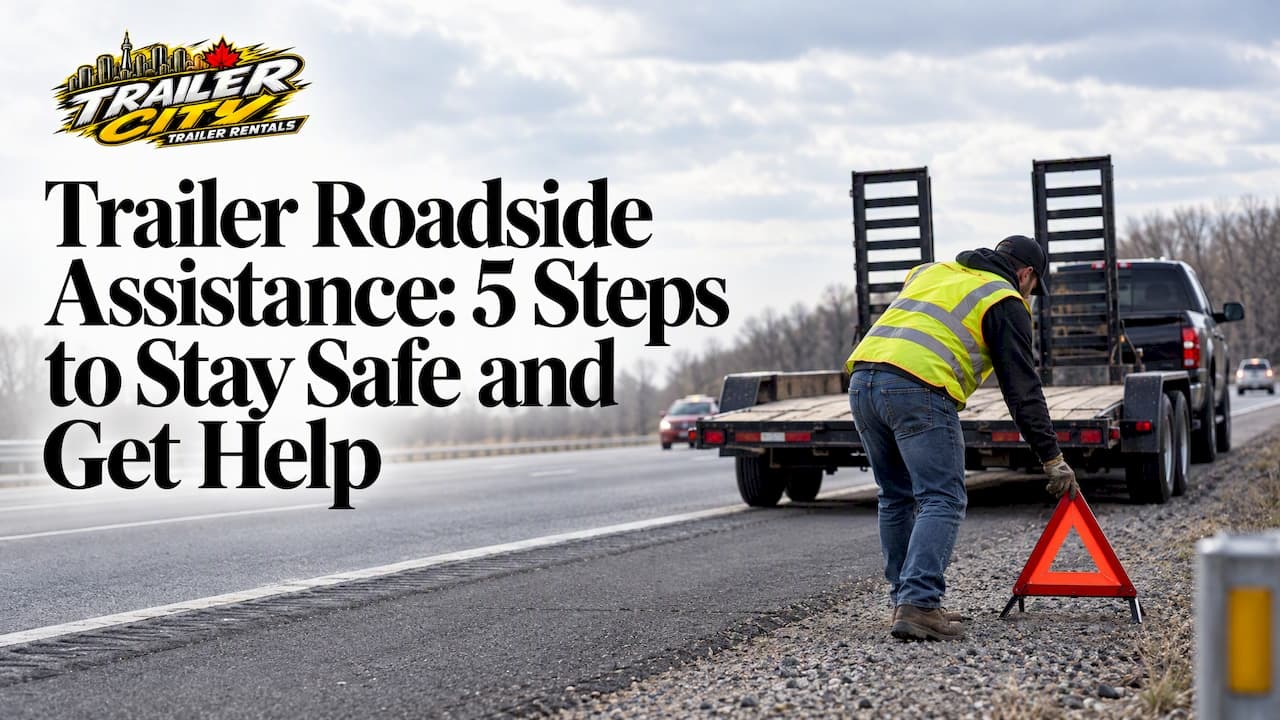
- Place warning triangles or cones behind the trailer in the pattern recommended by the FHWA's emergency traffic control guidance if it's safe to exit the vehicle.
- Stay inside the vehicle with your seatbelt on if you're on a high-speed shoulder, in poor visibility, or in heavy traffic.
- Call a trailer-capable roadside service and describe your location, trailer type, hitch style, and any visible damage.
- Take a few photos of the hitch, tires, and damage to send to the dispatcher if your phone has signal.
Pro Tip: Keep a flashlight and a phone charger with your emergency kit. Dead batteries and dark shoulders turn a quick fix into a long wait.
What roadside services for trailers actually do
Not every call needs a tow truck. Roadside providers generally offer several forms of help, and knowing which one you need speeds up dispatch:
- Mobile repair covers tire swaps, light and wiring fixes, brake adjustments, and bearing or axle checks that a technician can handle on-scene.
- Towing applies when the trailer or the tow vehicle isn't safe to drive, or when a problem needs shop diagnostics the roadside tech can't perform on the shoulder.
- Recovery and winching comes into play when a trailer is stuck, jackknifed, or rolled, and often requires heavy equipment plus a lane closure.
- Specialized tasks like landing gear repair, breakaway-brake battery replacement, or redistributing a shifted load fall somewhere between mobile repair and a full shop visit.
Telling the dispatcher exactly what happened, rather than just "my trailer broke down," helps them send a technician with the right tools instead of a tow truck for a problem a wrench could have fixed in ten minutes.
What affects ETA and price: realistic expectations
Response time and cost both hinge on a handful of variables you can ask about upfront:
- Urban calls typically get faster response than rural ones, and after-hours or holiday calls often carry a premium.
- Light service, like a tire change or jump start, costs less than a heavy-duty tow or a winch recovery that requires specialized rigging.
- Distance from the shop to your location and then to the repair facility both factor into the final bill.
Trailers over 2,000 kg gross trailer mass depend on a correctly rigged breakaway brake system that engages automatically and holds the brakes for at least 15 minutes if the trailer disconnects. That detail matters when you're describing your trailer to a dispatcher, since heavier trailers may need different towing equipment than a small utility trailer.
When you call, ask for an estimated time of arrival, the hookup fee, the per-mile rate if you need a long tow, the hourly labor rate, and what payment methods they accept. Getting those answers before the truck leaves the yard avoids surprises later.
How to make the scene safe using traffic control
Hazard lights tell other drivers something is wrong, but they don't tell them where to steer. The FHWA's field guidance for safety and service patrols recommends treating emergency lighting as a signal, not a traffic-control plan.
- Deploy cones or warning triangles upstream of your trailer in a taper pattern if you're carrying them and it's safe to walk the roadway.
- Keep emergency flashers running at all times, but don't rely on them alone to redirect traffic around your trailer.
- If you're blocking a lane, stopped on a high-speed road, or visibility is poor, call emergency services and ask for help managing traffic.
Federal rules under 49 CFR Part 393 Subpart H require certain warning devices for stopped commercial vehicles and restrict the use of flame-producing flares in some conditions. Even if your rig isn't a commercial unit under that rule, the same logic applies: physical warning devices placed well behind the trailer give approaching traffic time to react that lights alone can't provide.
Information and photos to gather before the operator arrives
A technician who knows what they're driving into works faster once they're on scene. Have these details ready before you make the call:
- Your trailer's VIN, make and model, and gross trailer weight if you know it.
- The hitch and coupler type, plus whether your brakes are electric or hydraulic.
- Clear photos of the full rig, a close-up of the hitch and coupler, the damaged area, and the license plate.
- Whether the trailer is currently loaded, what it's carrying, and how the load is secured.
Dispatchers use this information to decide whether to send a light-duty service truck or something heavier, and giving it upfront often shaves real time off your wait.
Fast criteria and exact questions to ask when you call
Not every roadside number in your phone can actually handle a trailer. Before you commit to a provider, run through this short screen:
- Ask what their maximum towing capacity is and whether it covers your trailer's loaded weight.
- Ask whether they handle winch or recovery work, not just flatbed towing.
- Ask for an ETA, the hookup fee, and whether rates change after hours.
- Ask whether they're willing to accept photos ahead of arrival to confirm the right equipment is dispatched.
- Listen for clear, specific answers and confirm they carry documented insurance and licensing before you hang up.
A provider who hesitates on capacity or dodges the fee question is one worth skipping, even if they're the first number that answers.
Coverage specifics by trailer type: flatbed, enclosed, and more
A flatbed or car hauler breaking down on the shoulder is a different problem than an enclosed cargo trailer doing the same thing, and roadside providers treat them differently.
Flatbeds and flat deck trailers carry exposed loads, so a breakdown often means securing or repositioning cargo before the trailer can move at all. A shifted load on an open deck is visible from the road, which raises the urgency of getting warning devices out and the load re-secured before a tow truck even arrives.
Enclosed cargo trailers hide their contents, so the dispatcher needs to know what's inside and roughly how much it weighs, since that affects both the tow vehicle's capacity and how carefully the trailer needs to be handled during recovery. Enclosed trailers also tend to have more complex wiring runs for interior lighting or climate control, which can complicate an electrical fault compared to the simpler wiring on a basic utility trailer.
Dump trailers add hydraulic systems into the mix. A roadside tech checking a dump trailer may need to address a stuck hydraulic ram or a bed that won't fully lower before the trailer is safe to tow, which is a different skill set than a tire change.
Utility trailers are usually the simplest case: lighter weight, simpler brakes, and fewer moving systems, which is part of why they're often the fastest trailer type for a roadside provider to turn around. Knowing which category your trailer falls into, and saying so clearly on the phone, helps the dispatcher send a technician who's actually equipped for the job.

Maintenance steps that prevent roadside issues before you tow
Most trailer breakdowns trace back to something that could have been caught in a driveway inspection. A quick pre-tow routine catches the majority of common failures before they turn into a shoulder-of-the-highway problem.
Check tire pressure and tread on every tire, including the spare, before every trip. Low pressure is one of the most common contributors to blowouts and loss of control on a loaded trailer, according to trailer-safety guidance that also flags improper coupling and skipped lug nut checks as frequent culprits.
Test your breakaway brake system before you leave, not after something goes wrong. Pull the pin, confirm the trailer brakes engage, and check that the breakaway battery holds a charge, since a dead breakaway battery means the system won't do its job if the trailer actually separates from the tow vehicle.
Inspect safety chains, the coupler latch, and the hitch ball for wear or improper sizing. A loose or mismatched coupling is one of the most preventable causes of a trailer coming loose on the road.
Walk the trailer's lighting and wiring connections before every tow, checking brake lights, turn signals, and running lights. A short in the wiring harness is a common, low-cost fix when caught early and an expensive roadside call when it isn't.

Common causes of trailer roadside failures
A handful of issues account for most of the calls roadside providers field for trailers. Tire failure tops the list, usually from underinflation, overloading, or dry-rotted rubber that finally gives out under highway speeds.
Electrical faults come next, often a blown fuse, a corroded wiring connector, or a short in the harness that knocks out brake lights or turn signals. Brake problems, particularly on electric brake systems, can stem from a worn controller, a disconnected breakaway cable, or brakes that were never adjusted properly after the last haul.
Coupling and hitch failures round out the common list: a trailer that wasn't fully latched, a hitch ball that doesn't match the coupler size, or safety chains that were skipped entirely. Bearing and axle issues also show up with some regularity, especially on trailers that sit unused for long stretches between hauls, since bearings can dry out or seize without regular grease service.
Each of these causes is addressable with the maintenance routine above, which is exactly why providers who answer the phone will often ask what led to the breakdown. It helps them triage the call and gives you a head start on preventing a repeat.
A field note on handling trailer breakdowns
Years of helping customers get trailers on and off the road have made one thing consistent: the drivers who come out ahead are the ones who control the scene first and worry about the fix second. Warning devices and a clear call to the right provider beat panic every time.
— Ryan
Trailer City: a practical option when your trailer stays down
When a breakdown takes your trailer out of service longer than your project can absorb, renting a replacement keeps work moving while repairs happen elsewhere. We offer dump, enclosed, flat deck, utility, and car hauler trailers with pickup options. Check our booking details for deposit requirements and current pricing.

Our online reservation system lets you book a replacement trailer, and if your bigger need is simply moving material rather than hauling your own trailer, our delivery and junk removal services can cover that gap too. For a quick utility swap specifically, our utility trailer inventory is available to view in our inventory. This isn't a substitute for emergency roadside help, it's what keeps your schedule intact once the tow truck has done its job.
FAQ
What all does roadside assistance offer?
Roadside assistance for trailers typically includes mobile repairs like tire changes, light and wiring fixes, and brake adjustments, plus towing when the issue can't be fixed on-scene. Some providers also offer recovery and winching for stuck or rolled trailers, along with specialized help like breakaway-brake battery swaps.
What to do if a car breaks down on the highway?
Move to the shoulder or as far off the travel lane as safely possible, turn on hazard lights, and set the parking brake. Deploy warning triangles or cones behind the vehicle if it's safe to exit, following FHWA traffic-control guidance, and call emergency services if you're stuck in a live lane or visibility is poor.
What to do if I have a flat tire and no AAA?
Pull off the road safely, set hazards, and call a local roadside repair or towing company directly rather than relying on a membership service. Many independent providers offer the same tire-change and mobile-repair service without a membership, so search for roadside help in your area and confirm they handle trailers if that's what you're driving.
How much does roadside assistance charge for a flat tire?
Pricing depends on your location, the time of day, and whether the provider charges a flat service fee or an hourly labor rate, so there's no single number that applies everywhere. Ask for the hookup fee, labor rate, and any after-hours premium when you call so you know the cost before the truck arrives.
Sources
The safety steps in this guide aren't improvised. They draw on a small set of documents that govern how roadside incidents are supposed to be handled:
- Field Operations Guide for Safety/Service Patrols: Emergency Temporary Traffic Control - FHWA Office of Operations
- eCFR :: 49 CFR Part 393 Subpart H -- Emergency Equipment