
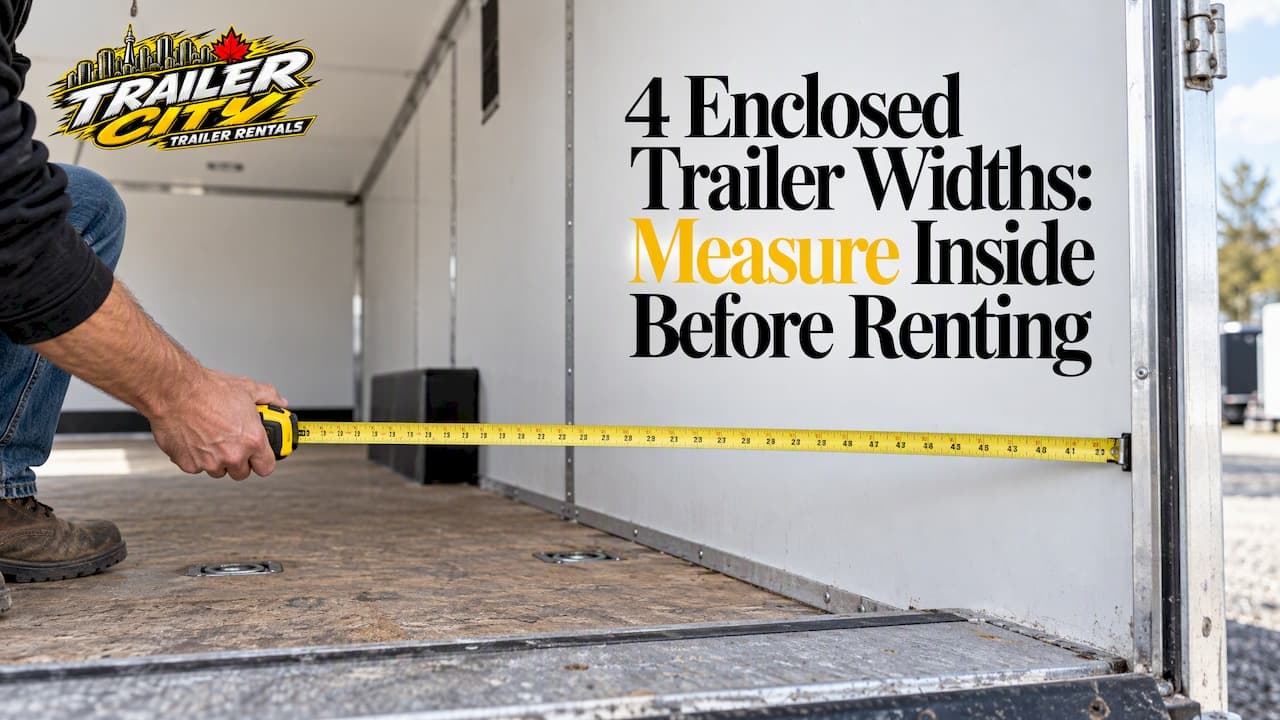
Enclosed trailers come in four common nominal widths, 5', 6', 7', and 8.5', paired with length groups that match them to real jobs: small (4 to 8 feet) for boxes and gear, medium (10 to 14 feet) for motorcycles and household moves, large (16 to 20 feet) for vehicles and bigger equipment, and extra-large (24 to 32 feet) for pallets and commercial loads. Before you commit to a size, check the ramp opening and your tow vehicle's rated capacity.
TL;DR:
- A trailer labeled 7 feet wide usually provides only 6 feet 6 inches to 6 feet 9 inches of interior width, with wheel wells narrowing clearance further.
- Standard ramp openings are typically 75 to 90 inches wide; check the actual door, threshold, and interior height against your vehicle before booking.
- A 6x10 fits a single motorcycle or yard equipment, a 7x14 fits two motorcycles, and an 8.5x16 can accommodate a small car.
- Check your specific vehicle’s published trailer weight rating and the trailer’s payload limit; keep tongue weight near 10% to 15% of gross trailer weight.
Table of Contents
- 1. What do nominal trailer widths actually mean?
- 2. Which length fits your load, from small to extra-large?
- 3. Where to measure for a confirmed fit
- 4. A quick checklist before you load or book a trailer
- 5. Matching trailer size to your tow vehicle's rating
- 6. A short decision guide for picking your trailer size
- 7. How renting removes the size-guessing problem
- 8. Materials and construction that affect size and durability
- My rule of thumb for picking a trailer size
- Reserve the right enclosed trailer size today
- FAQ
- Sources
1. What do nominal trailer widths actually mean?
A trailer labeled "7 wide" or "8.5 wide" is describing its exterior frame width, not the space you actually get to load into. Wall framing, interior paneling, and structural supports eat into that number, so the usable interior is narrower than the nominal size suggests. This gap matters most when you are trying to fit something close to the trailer's rated width, like a pallet or a wide piece of equipment.
Here is roughly what to expect once you account for that framing loss:
- 5' nominal width: usable interior clear width typically runs about 4'6" to 4'9", enough for smaller cargo, bikes, or light equipment.
- 6' nominal width: interior clear width usually falls between 5'6" and 5'9", a common pick for motorcycles and household goods.
- 7' nominal width: interior clear width generally lands around 6'6" to 6'9", wide enough for most standard pallets and side-by-side bins.
- 8.5' nominal width: interior clear width commonly measures 8'0" to 8'3", the tier most car haulers and commercial operators choose for pallet rows or vehicle clearance.
Interior height follows a similar pattern. Standard models often offer 6' to 6'6" of headroom, which works fine for stacked boxes or motorcycles but gets tight if you need to walk upright while loading. Taller trailers, sometimes built with 7' or higher interiors, make sense when you are hauling upright appliances, stacked furniture, or need room to maneuver a pallet jack inside without ducking. If your cargo list includes anything tall or you plan to walk the trailer while loading, confirm the interior height before you measure anything else.
2. Which length fits your load, from small to extra-large?
Once you know your width tier, length decides what actually fits inside. Lengths run from about 6 feet up to lengths typical for commercial use, and most buyers and renters sort them into the same four groups.
- Small (6' to 10'): a 6x10 handles yard tools, a few boxes, patio furniture, or a single motorcycle with room to spare.
- Medium (10' to 14'): a 6x12 or 7x14 is the sweet spot for two motorcycles, a studio apartment move, or an ATV with gear strapped alongside it.
- Large (16' to 20'): a 7x16 or 8.5x16 fits a UTV, a small sedan prepped for enclosed transport, or a mixed load of furniture and appliances for a full household move.
- Extra-large (24' to 32'): an 8.5x24 or 8.5x32 is built for commercial use, holding multiple pallets, bulk inventory, or a car plus extra cargo for dealers and movers.
A 6x10 is a popular starting point because it clears most garage doors and still swallows a riding mower or a stack of moving boxes. Step up to a 7x14 and you gain enough length for two motorcycles parked front to back, or a one-bedroom apartment's furniture in a single trip. The 8.5x16 is the size most people reach for when hauling a small car, since the extra width clears mirrors and the extra length leaves room for tie-down access at the rear.
At the top end, an 8.5x24 or larger is less about convenience and more about volume: palletized freight, multiple pieces of equipment, or a vehicle plus spare parts for a shop on wheels. These sizes are common with commercial haulers and events that need to move inventory in one run rather than several.
Vehicle loads deserve a second look at interior height and ramp width before you book. A motorcycle or ATV needs enough ramp width to walk alongside without scraping a mirror, and a car needs both the ramp length and the interior height to clear its roofline during loading.
Pro Tip: Measure your tallest item with its wheels or feet on the ground, then add a few inches before matching it to a trailer's interior height, since ramp angle can eat up headroom near the door.

3. Where to measure for a confirmed fit
The nominal size on a listing tells you very little about whether your cargo will actually fit. Four measurements matter far more: clear width between wheel wells, floor-to-ceiling height, door and ramp opening dimensions, and how much the front geometry shortens your usable floor.
Wheel wells intrude into the interior on most trailers, and that intrusion is what actually limits side-by-side placement, not the nominal width printed on the spec sheet. If you are loading two items side by side, like a pair of motorcycles or two pallets, measure the narrowest point between the wells rather than trusting the full interior width number.
- Clear width between wheel wells: often 6 to 12 inches narrower than the quoted interior width on trailers with wheel wells built into the cargo area.
- Ramp door width: typically 75 to 90 inches on standard enclosed models, with wider options available on 8.5' trailers built for vehicle hauling.
- Ramp door height or threshold angle: affects ground clearance for lowered vehicles and anything with limited approach clearance.
- V-nose front: reduces usable floor length compared to a flat-front design of the same nominal length.
A v-nose front is common on trailers because it improves towing stability, but it comes at a cost to usable space. Industry measurement guides note that interior width can run 6 to 12 inches less than the nominal figure, and v-nose fronts or wheel wells further reduce usable length and width, which means the floor space you actually load into is smaller than the trailer's advertised dimensions suggest. To get your real usable length, measure from the point where the v-nose interior wall ends to the rear door threshold, not from the exterior hitch to the rear bumper.
4. A quick checklist before you load or book a trailer
A short walk-around with a tape measure prevents most of the mismatches people run into on moving day.
- Measure the clear width between wheel wells, not just the stated interior width.
- Measure the ramp door opening, both width and height, against your tallest and widest item.
- Confirm interior ceiling height clears your cargo with a few inches to spare.
- Check the trailer's GVWR and payload rating against your total cargo weight.
- Note axle placement, since axles set closer to the rear can affect tongue weight and backing stability.
For packing, orient pallets with their long side matching the trailer's length when possible, since this uses the v-nose taper more efficiently. Stack lighter items on top of heavier ones, and secure everything to E-track or D-rings rather than relying on friction alone. A common mismatch is a pallet that fits the interior width but not the clearance between wheel wells. The fix is usually to load it further back where the wells narrow less, or to split it into two smaller pallets.
5. Matching trailer size to your tow vehicle's rating
Picking the right trailer size solves half the problem. The other half is confirming your tow vehicle can actually handle it, and that comes down to three numbers: GVWR (gross vehicle weight rating), GCWR (gross combination weight rating), and TWR (trailer weight rating). You will find GVWR on your vehicle's door-jamb placard, while GCWR and TWR are typically listed in the owner's manual or the manufacturer's towing guide.
SAE J2807 establishes the performance criteria manufacturers use to calculate GCWR and TWR, and it has been the recommended industry practice for vehicles from model year 2011 onward. The practical takeaway is that two trucks with similar size and horsepower can carry very different trailer weight ratings, so never assume capacity based on vehicle size or trailer length alone. Always check your specific vehicle's published TWR.
A few quick checks keep a loaded trailer safe on the road:
- Keep tongue weight around 10 to 15% of the gross trailer weight to avoid sway.
- Distribute cargo evenly front to back and side to side rather than clustering weight at the rear.
- Verify your tires and wheels are rated for the loaded weight, not just the empty trailer weight.
If your hauling setup crosses into heavier combinations or commercial use, the FMCSA's regulatory definitions around driver qualifications and vehicle classifications are worth a look, since they can affect what counts as a commercial towing operation.
6. A short decision guide for picking your trailer size
Once you understand widths, lengths, and tow ratings, choosing a size comes down to four steps.
- List every item you plan to haul, with dimensions and weight, including the bulkiest and heaviest pieces.
- Shortlist trailer sizes based on clear interior width and ramp opening, not just the nominal size.
- Check your tow vehicle's TWR and the trailer's payload rating against your total cargo weight.
- If renting, inspect the specific unit in person and do a dry-fit or test load before you drive off.
That last step catches problems no spec sheet will show you, like a slightly narrower wheel well gap or a ramp that sits lower than expected.
Pro Tip: When your cargo list is close to the edge of one size tier, size up rather than down. An extra two feet of length costs little compared to the hassle of a return trip for a bigger trailer.
7. How renting removes the size-guessing problem
We built our rental fleet so you can confirm the right size without committing to a purchase. We stock a wide range of enclosed trailers alongside utility, dump, and car hauler models, all bookable through our online reservation system. Renting lets you test-fit your actual cargo before you ever consider buying.
8. Materials and construction that affect size and durability
The material a trailer is built from affects both its usable dimensions and how long it holds up. Aluminum-skinned trailers tend to be lighter, which can translate into slightly more usable payload within the same GVWR, since less of the weight budget goes to the trailer's own structure. Steel-framed trailers typically weigh more but often hold up better under repeated heavy loading and rough terrain.
Wall and roof construction also shapes interior space. Trailers with screwed aluminum siding over a wood-framed structure are common and tend to offer slightly thicker walls than all-aluminum welded designs, which can shave an inch or two off interior width compared to the nominal size. Roof style matters too: a flat roof maximizes interior height evenly across the trailer, while a rounded or radius roof can reduce usable height near the side walls even if the center peak measures taller.
Floor material affects durability more than dimensions. Plywood floors are standard and perform well under normal loads, while some trailers use heavier-rated flooring for repeated equipment loading or pallet jack traffic. If you are hauling anything with wheels, like a pallet jack, ATV, or UTV, ask about floor rating before you load, since repeated point loads wear differently than evenly distributed cargo.

Axle configuration ties into construction as well. Single-axle trailers are common on smaller sizes and keep weight down, while tandem-axle setups appear on longer and wider models, adding stability and higher payload capacity at the cost of some additional tongue weight to manage.
My rule of thumb for picking a trailer size
When a load sits right between two size tiers, I always size up. The extra few feet costs little in rental terms and saves you from the far more common problem: a trailer that is just slightly too small once you start loading. Measure twice, choose the bigger option when in doubt.
— Ryan
Reserve the right enclosed trailer size today
Measure your cargo, match it to a width and length tier, then book online in minutes. We offer enclosed trailers from $85 per day with no deposit required and a price guarantee that beats any competitor by 10%. Browse our current trailer inventory or check the rental agreement before you reserve, and if an open utility trailer fits your load better, our utility trailer lineup is available too.

FAQ
How big is a 7x14 enclosed trailer?
A 7x14 enclosed trailer has a nominal width of 7 feet and a nominal length of 14 feet, with usable interior width typically closer to 6'6" to 6'9" once framing and wheel wells are factored in. It comfortably fits two motorcycles, a one-bedroom apartment's furniture, or an ATV with extra gear.
How big is a 6x10 enclosed trailer?
A 6x10 enclosed trailer measures 6 feet wide and 10 feet long on paper, with real interior clear width usually around 5'6" to 5'9". It suits a single motorcycle, yard equipment, patio furniture, or a modest load of moving boxes.
Which is better for an enclosed trailer, a 7x14 or a 7x16?
Both share the same nominal 7-foot width, so the choice comes down to length and what you are hauling. A 7x16 gives roughly two extra feet of floor length, useful for a longer vehicle, extra gear alongside motorcycles, or a slightly larger household move, while a 7x14 is easier to maneuver and tow in tighter spaces.
How long is a 24ft enclosed trailer?
A 24-foot enclosed trailer falls into the extra-large length group, typically paired with an 8.5-foot nominal width. This size is common for commercial hauling, multiple pallets, or a vehicle plus additional cargo in a single trip.